Friday, February 8, 2019

This Week in Punta Gorda History - One of the Most Farmous Tennis Players of all time Visits in February 1931


William Tatem Tilden II , called  "Big Bill", was born on February 10, 1893 - over 125 years ago this coming week. Considered one of the best tennis players of all time, he was the world's number one  player for six years from 1920 through 1925 winning 15 Major singles titles including ten Grand Slam events.

In 1920, Tilden became the first American to win Wimbledon.  He also won a record seven U.S. Championships titles, and dominated the world of international tennis in the first half of the 1920s, and during his 18-year amateur period of 1912–29, winning 138 of 192 tournaments. In 1929, Tilden became the first player to reach 10 finals at a single Grand Slam event, which remained a record until Roger Federer reached his eleventh in 2017.

In 1931, Tilden needing money turned pro, and was snared for a tournament in Punta Gorda by Barron Collier.  Collier was the largest land owner in Southwest Florida. He had  invested millions of dollars to transform and in development of  the wilderness, including drainage of the Everglades and construction of the Tamiami Trail.  In 1924 he purchased and later remodeled the old Hotel Punta Gorda and reopened it as a grand renaissance-style Floridan hotel to which he hoped to draw famous sports legends of the time to garner prestige for  the area. As part of his development of south Florida, he planned to make Charlotte County the sports center of the south during the winter season.  He had had new tennis courts constructed at the hotel which cost him $15,000 (almost $250,000 in today's dollars).

Tilden played his first professional tennis match in Punta Gorda on February 2, 1931 beating Francis T. Hunter 6-3, 6-4.3-6, 7-5.  Later in the exhibition event, he went on to defeat Emmett Pare to win the prize money.  The court area had seating for over 600 people and buses brought people from Palm Beach, Tampa and Miami to watch the games.

Theresa  Murtha

(Photo courtest Burgett Brothers Photography Collection, Hillsborough Public Library)

Monday, January 21, 2019

Coming to Punta Gorda -- The Railroad Arrives

The coming of the Florida Southern Railroad whose last track into Trabue (the original name for Punta Gorda) was laid in July of 1886 marked the beginning of the development of the town.  For it was then with more direct and comfortable transport into the town and the building of the first hotel to attract passengers that people from the north with money to invest arrived in Punta Gorda.

Isaac Trabue convinced the railroad owners to come to his new town rather than the other choice, Charlotte Harbor, on the north side of the Peace River.  The Hotel Punta Gorda which was built on land dedicated to the railroad by Isaac Trabue first opened as best we can tell on February 20, 1886 - widely advertised in northern newspapers of the time.  It's first true season, however, occurred starting in December of 1886 shortly before Trabue was incorporated as Punta Gorda.


The railroad built two wharves to support passengers and freight and also steamboat passage to and from New Orleans and Key West and later to Fort Myers.  The first was immediately adjacent to the hotel, so railroad passengers could disembark there.  The second was located further west (starting on land where the Isles Yacht Club is today). That wharf was referred to as the long dock.

Albert W. Gilchrist who was the main surveyor laying out the route from Bartow to Trabue became one of the new town's prominent landowners and citizens and later a Governor of Florida


Monday, October 29, 2018

Some Punta Gorda Halloween History


Halloween has long been a popular holiday in Punta Gorda.  Perhaps one Halloween tradition that most are familiar with is the Punta Gorda Masons  gift of free ice cream treats to Trick or Treaters every year in Gilchrist Park.  

This tradition started with Albert Gilchrist, a Mason in early Punta Gorda and the only Punta Gordan to become Governor of Florida, didn't have children of his own.  He loved kids though.  When he walked down Marion Avenue, he frequently gave kids pennies he kept in his pocket so they could buy ice cream or candy from the local store near his apartment above his realty business.  But he forecast a day when he wouldn't be able to give the kids this present.  So  in his will, in addition to generous bequeaths to numerous local charities, for example,  funds benefitting he local high school, funds for poor children, he specified something very special to be used on Halloween.  He set aside money to be used for ice cream.  The Masons kept the money and use the interest on it to buy ice cream for kids every Halloween.

But  Punta Gorda had many other ways to mark the night.  Some stories include pranks by youngsters - ringing church bells for instance. But for the most part it involved parades, contests and dances. For years the town had an annual Halloween parade down Marion Avenue.  There were also contests where queens and princesses were selected from the local school children followed by a Halloween dance at the Woman’s Club.  The photograph above was a parade sometime in the 1950s.

Monday, July 23, 2018

Today and Yesterday - A History of the Hotels on Charlotte Harbor Bay in Punta Gorda


Hotel Punta Gorda 
The Punta Gorda waterfront from its earliest days was seen as a draw for tourists and snowbirds. Not surprisingly,  it became the site of the original hotel.  Once the railroad was convinced to bring its trains into Isaac Trabue's new town, the Florida Southern realized it needed a hotel to draw northerns customers to use the line.  Before the first house was built on Marion Avenue, J.B. Williams of Patlatka was contracted to build the Hotel Punta Gorda. Luxurious for the time, the hotel was a three-storied structure with towers that extended higher. Advertisements for the resort proclaimed that the hotel had gas, electric bells, steam heat and open fire places.

Opened in early 1887 for the winter season, the management brought staff from resorts in Maine to operate the new hotel.  Initially a success, over the course of time the Hotel Punta Gorda had its ups and downs.  Promoting its stunning location on Charlotte Harbor, tropical ambiance, warm weather and first-class facilities, the hotel  initially appealed to wealthy yachtsmen and fishermen.  Some of its early guests included W.K. Vandervilt, John Wannamaker and Andrew Mellon.  However, over time, it lost its appeal as other newer Florida resorts competed with the Punta Gorda hotel with their beaches and more attractive amenties.


Hotel Charlotte Harbor 
In the 1920s envisioning a new automobile-driven market for hotel rooms from the Tamiami Trail he had  just bankrolled, Barron Collier with Cornelius Vanderbilt acquired control of the Hotel Punta Gorda and remodeled and enlarged the facility.  It was reopened in 1927 with  a more Italianate style with a new tower and fifth floor ballroom as the Hotel Charlotte Harbor.  Guests to the new resort included Dan Beard (Commissioner of the Boy Scouts), Jimmie Walker, Clarence Darrow and many  sports legends of the time, like Bill Tilden.  This facility also had its ups and downs and late in its life was changed to a hotel/spa called the Charlotte Harbor Spa.  Then in August of 1959, it was destroyed in a fire, suspected of being arson.

Howard Johnson's Motor Lodge


In 1960s as the Punta Gorda Shopping Mall was being developed on the site of the old hotel, Al Johns and Bud Cole of Punta Gorda Isles, Inc, bought the 1000 feet water property at the end of the mall from the developer, Wilbur Marvin, and built the Howard Johnson's Motor Lodge pictured.  It opened in the summer of 1967 with 64 units.


Shortly thereafter,  Fred Babcock built a Holiday Inn  west of the Howard Johnson.  The original property there had been the home of Perry and Marion McAdow in the late 1890s and was converted into a 12-room  Inn - The Bayview Lodge - in the 1940s. The Holiday Inn opened in the summer of 1968 had 102 rooms, a 200-seat dining room, a cocktail lounge, two banquet rooms and a coffee shop. (Photo below depicts it under construction.)

Babcock's Holiday Inn under construction


In the late 1990s, the Holiday Inn was changed to a Best Western (where the PG Waterfont Hotel and Hurricane Charley's is today) and the Holiday Inn franchise was transferred to the Howard Johnson's near the new Barron Collier bridge. (41 North).  The Best Western was badly damaged during Hurricane Charley in 2004, and soon afterwards was remodeled somewhat and became the PG Waterfront Hotel. The Holiday Inn destroyed by the Hurricane was torn down. 

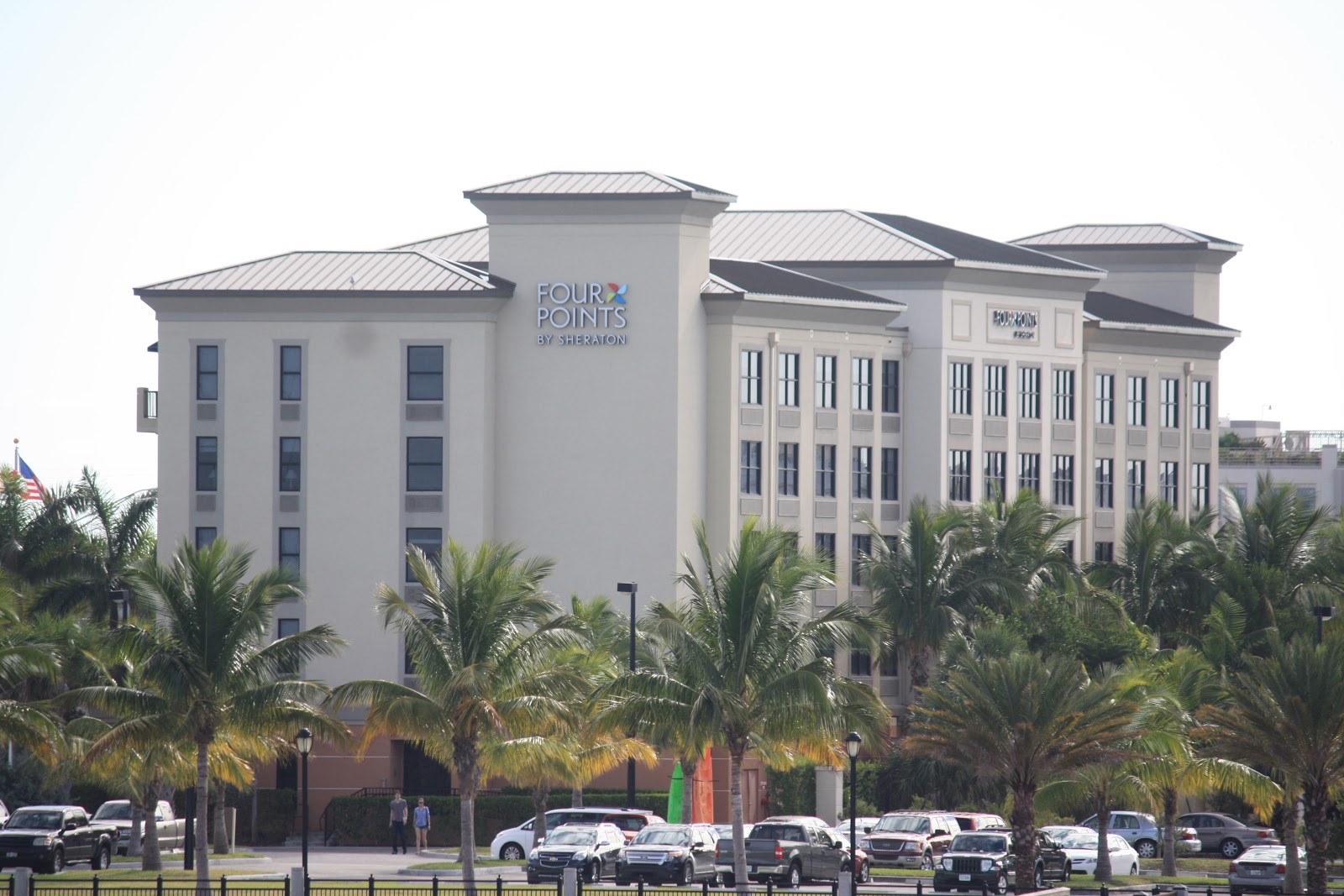
Today closest to the location of the original hotel the Four Points Sheraton sits nearest the harbor with the new Springhill Suites right behind it.  


Four Points Sheraton


Springhill Suites by Marriott 


Friday, July 20, 2018

Charlotte Harbor- New Home of Sunseekers Resort - is the Oldest Settlement in the County


Often confused with the name of the huge bay to its South from which its own name was derived or incorrectly merged with neighboring Port Charlotte, Charlotte Harbor, the community north of the Peace River was actually the oldest settlement and town in what is now Charlotte County.   Soon through the emergence of a new development (SunSeekers’ Resort) which will comprise a major portion of Charlotte Harbor, new light will be shone on this often forgotten historic area.

Charlotte Harbor was platted in the 1860s around a point (where Live Oak Park is situated and where the two 41 bridges merge today) in an area thought to have been inhabited by indigenous peoples over 3,000 years ago.   During the Civil War, cattle were shipped to the Confederate Army from a wharf there.  After the war, the wharf continued to operate as a focus of trade with Cuba and other Caribbean islands. The old town consisted of a grid of streets developed with homes, stores, a post office, and a church.

Referred to at one point in its history as Hickory Bluff, the name Charlotte Harbor came from a post office designation – a news article from 1879 referring to the town notes “with its post office absurdly called "Charlotte Harbor.”    John Bartholf referred to the town as Hickory Bluff as late as 1882 in a pamphlet he wrote about the Charlotte Harbor area.  But for most of its history it has been known as Charlotte Harbor.  He noted in his pamphlet that the town was located amidst a ridge of pine, scrub and hammock, extending four miles along the water. At the time about twelve families lived there including the Bartholfs, the Knights, the DeCosters (Nathaniel DeCoster owned an area he called Harbor View), the Platts and the Durrances.  Many of the men in these families were Civil War veterans.  

Bartholf (said to be a great grandfather of PGI developer Al Johns) promoted Hickory Bluff (Charlotte Harbor) as a resort for invalids and pleasure seekers with gorgeous sunsets and moonlight views.  He further claimed that a residence there could not be excelled by any other point in South Florida.  Surely, what the marketers of Sunseekers' Resort might say as they draw today's  potential new residents to the location that was first announced to the world over 135 years ago.