Sunday, March 8, 2020

Martha Susanna Sandlin Morgan - a True Punta Gorda Pioneer Woman

Martha Suzanna Sandlin Morgan Pioneer Business Woman 1860-1946

It was James L. Sandlin, an early pioneer and former City Councilman and Mayor of Punta Gorda, that brought his 25-year old sister, Martha Suzanna to the nascent town of Trabue in early 1886. It was there that she was introduced to and soon married Sandlin’s business partner, James M. Morgan, a cattleman and owner of citrus, lumber and shipping businesses. It was a marriage arranged to cement the Morgan-Sandlin partnership.

One of Punta Gorda’s true pioneer women, Martha, after the early death of her husband, hired an architect to design and build a large, turreted house on Retta Esplanade (near the end of Sullivan Street) to raise their seven children: Frances, J. Henry, Jesse, Maude, Mary, Kate and Violet. All the while she continued to oversee her deceased husband’s large, local enterprise with the help of her children and grandchildren whom she engaged in the various businesses. She continued to do so until her death in 1946.

Martha owned all the lands that surround Alligator Creek, the location of her cattle ranch, orange groves saw mill, and storage facility for the Morgan Sandlin Shipping Company that ran ships up and down the coast of Florida to bring materials and goods to Punta Gorda.

She was instrumental in donating three acres on the west side of Taylor Road at the Alligator Creek Bridge for use as a dam site, which helped accommodate the city’s need for a water supply, and a park. Martha also was instrumental in the donation of land for the community’s cemetery on Alligator Creek, “Indian Springs,” and helped with funding the building of the First Baptist Church, where the Sandlin and Morgan families were among the first worshippers.

Her work effort and dedication to the community contributed greatly to the development of Punta Gorda.

Friday, February 21, 2020

The Story of the Ice Made at Berry Street


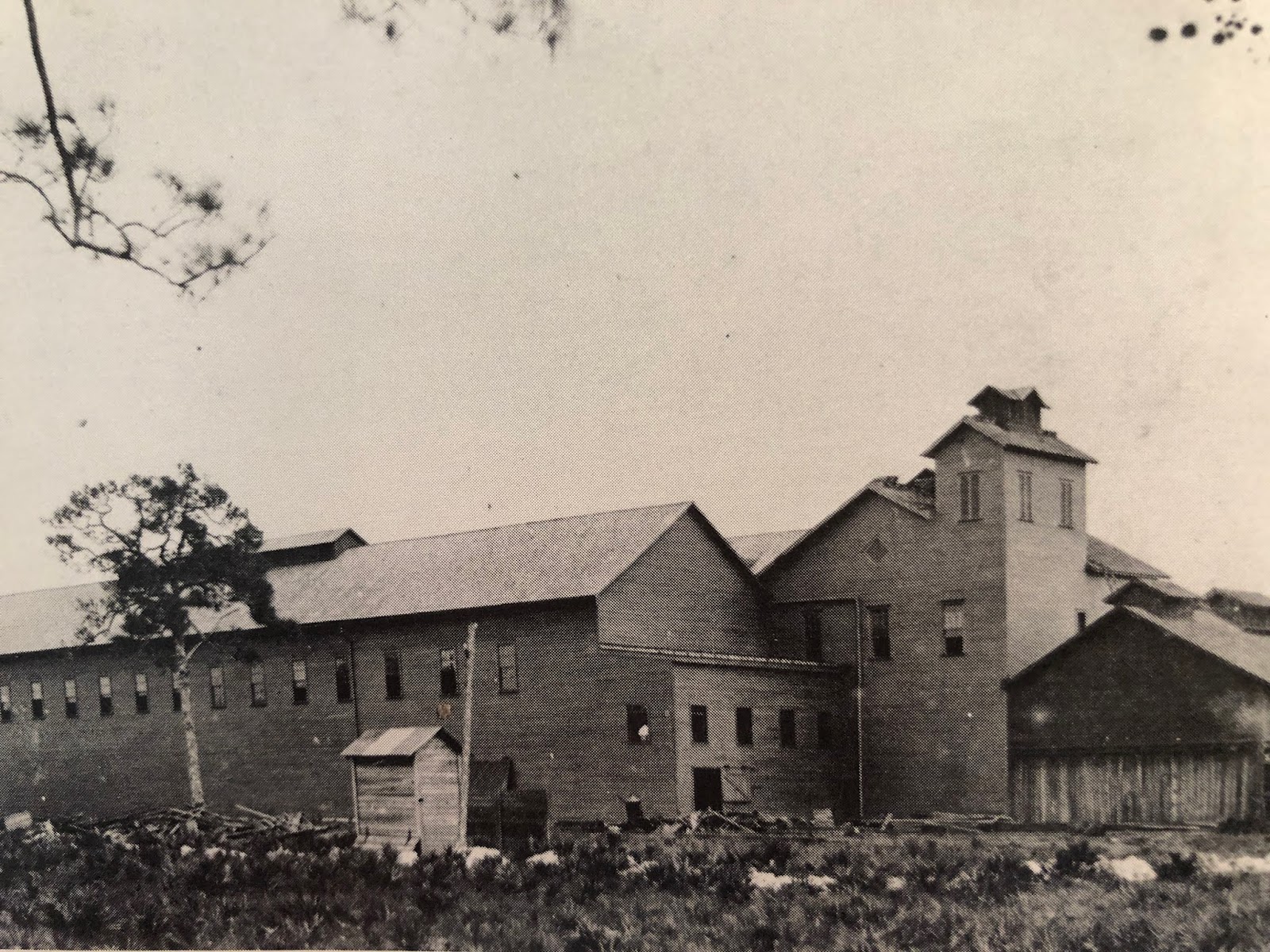
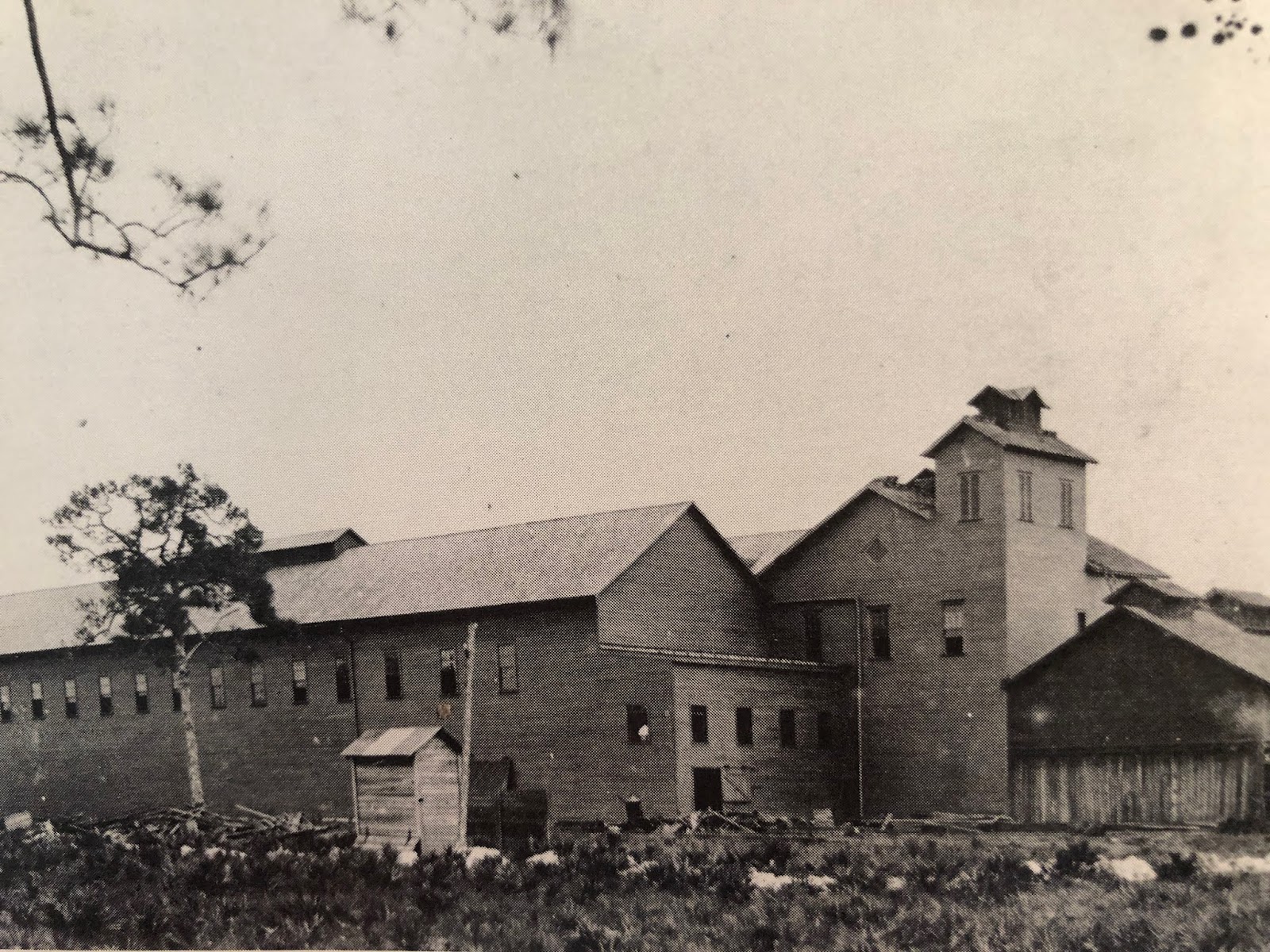
In around 1891 the enterprising founder of our town, Isaac Trabue, saw another way to help fund his retirement.  He opened the first Ice Factory designed to enable the delivery of fish north.  It was a steam-based plant located near Virginia between Berry and Shreve St.  The Florida Southern Railway ran through the area and onward west to the Long Dock which was located off the land where the Isles Yacht Club is today.  When you walk along the linear park in Punta Gorda, you are essentially on the beds where the railroad once ran. 

The plant turned out about 15 tons of ice a day, but only during the fishing season. Ice was slid down a shute to fishing boats that unloaded their catch over ice onto wagons where it was hauled back to the factory.  There it was packed onto box cars (on a railroad spur) for shipment on the Florida Southern Railway heading north from the Long Dock.  

Unfortunately for Trabue in 1895, a group of local businessmen organized another company, the Punta Gorda Ice and Power Company, that would be open all year, produce more ice per day, and be most importantly priced cheaper.  Townspeople thought that Trabue’s price for ice was exorbitant.  To make matters worse for Trabue’s plant, Henry Plant had fully acquired the Florida Southern in 1897 and his main business interests were in Tampa.  He pulled up the track leading to the long dock leaving Trabue’s plant stranded.

Not to be undone, in 1902 working with a group of investors from Philadelphia, Trabue opened with them the Consolidated Ice Manufacturing, Refrigeration and Fish Company with the intent of furnishing cheaper ice to the fish industry and then manufacturing fertilizer from trash fish.   The large plant was built in 1902 (looks as though from photographs that the remnants of the earlier plant were likely incorporated into the larger structure).  Then at the harbor near Berry a fertilizer building was constructed to process the fish for fertilizer.

This company failed to go into production and the building was abandoned and eventually torn down by the city after a small boy was killed by a timber that fell from the remains.  Remains of pilings on which the fertilizer plant rested can still be viewed near the Boat Club clubhouse on the bay. ( See earlier post about those remnants)

~Theresa Murtha

Sources:
Peeples, Vernon, Punta Gorda and the Charlotte Harbor Area
Williams, Lindsey, Out Fascinating Past
Maps and Photographs from the Vernon Peeples Collection, Punta Gorda History Center


Monday, February 17, 2020

Remnants of the Past Near the Punta Gorda Boat Club Clubhouse - Connection to the Consolidated Ice Plant


Research into one piece of history often leads to branches of  another piece.  And so it was in researching the history of the Punta Gorda Boat Clubhouse on the bay off Retta Esplanade.


If you wander into what is designated Shreve Park and meander to the back left of the Boat Club Clubhouse, you will discover large blocks of coquina-covered blocks.


We learned through research in newspapers, books and discussion with locals who were here in the 1950s that the blocks are remnants from the pilings where there was a fertilizer plant that stood here years ago.


The fertlizer plant was built on the bay in conjuction with the construction of the Consolidated Ice, Manufacturing, Refrigerated and Fish Company 3 blocks inland on Berry.  The Ice Building and the fertilizer plant were supposed to have worked together. Fertilizer was to be produced from fish remains.

Constructed in 1903 the ice factory was purported to be the second largest one in the country.  It containted three 150-ton ice machines and an electric light plan.  The ice was made from an artesian well nearby.  It had the capacity to freeze 50 tons of fish daily.  Unfortunately, it only opened for a very short while.


Recently a remnant from that plant was moved from where it was found to the linear park.  A sign was placed there commemorating it that will be dedicated this coming Thursday.


Research by Theresa Murtha

Sources:
Pearse, Eleanor, Florida's Vanishing Era
Peeples, Vernon, Punta Gorda and the Charlotte Harbor Area
Vernon Peeples Collection Photographs and Documents, Punta Gorda History Center
Punta Gorda Herald, 1902-1903
Discussions with Frank Desguin and Gussie Baker


Friday, January 10, 2020

How the Railroad Came to Punta Gorda (aka Trabue)


The first railroad to span Florida was completed between Fernandina and Cedar Key in 1861. Coastal vessels navigated between small existing villages and conveyed merchandise to the railroad terminus where it was shipped North or to the Gulf coast.

People living in southwest Florida at the time started making demands for a rail line to this area after the Civil War, and various settlements competed to become the end of that line. In 1866, Charlotte Harbor land owners were working to get the railroad line to terminate there. In 1867, newspapers reported that the terminus for a Gulf coast line site was between Tampa and Charlotte Harbor. Harrison Reed, the governor of Florida. In1868, petitioned Congress for aid to build a railroad to Charlotte Harbor.

By 1880, the South Florida Railroad Company, had completed a line to Orlando and was preparing to extend its line beyond there. Then in May of 1883, the Plant Investment Company, owned by Henry B. Plant, purchased a three-fifths interest in that railroad. The following month Plant, for $50,000, got the right to build a line from Kissimmee to Tampa. 

The South Florida Railroad constructed this branch, and the first train entered Tampa over the new line on January 22, 1884. Plant then worked out a settlement with the Florida Southern Railway whereby that company agreed not to build into Tampa but rather down the peninsula to Charlotte Harbor. Plant is said to have had an interest in the Florida Southern; that company and the railroads controlled by Plant never competed with each other.

The Florida Southern Railway had its origins in the Gainesville, Ocala, and Charlotte Harbor Railroad which was chartered in 1879 to build a line from Lake City to Charlotte Harbor with a branch to Palatka. A branch from Palatka to Gainesville was finished first, which was extended to Pemberton's Ferry, and later to Brooksville.

The South Florida Railroad then completed construction on a branch from that point to Bartow. The Florida Southern began surveys south of Bartow Junction, and by May 1885, it was reported that routes had been surveyed to Punta Gorda, Hickory Bluff (aka Charlotte Harbor town), and Pine Island. A month later survey crews under the direction of the South Florida Railroad were in the vicinity of Fort Ogden. Henry Plant is thought to have had a hand in the selection of the terminus.
In August of 1885 the Florida Southern railroad entered into a contract with the Plant Investment company and the South Florida railroad company to build the road from Bartow to Charlotte Harbor, which would be operated jointly.

Isaac Trabue, the founder of Punta Gorda, was very likely  the determining factor in making what was then Trabue the terminus of this rail line.  At the time there was a push for the rail to terminate on the north side of the Harbor at Hickory Bluff.  But Trabue had another vision.  His homesites at his self-named town of Trabue had not been selling well despite other marketing efforts.  He realized that if the railroad ended in his town that would change. Trabue went to Boston to discuss this option with the members of the board of directors of the Florida Southern. On September 6, 1885, he wrote his cousin, then the only resident of the town of Trabue: “If our place is to be the terminus the Yankees will build grand hotels and Trabue will be a city in reality."  Trabue and the railroad directors agreed that if he would deed one-half of his holdings in Trabue to the company, a line would be constructed through his property.

The first Florida Southern train crossed Shell Creek, on May 26, 1886.  Soon after trains were routinely running to Cleveland with connections by stream boat to Fort Myers. The last rail was laid by July 24, and the Charlotte Harbor Division of the Florida Southern was completed to Trabue (Punta Gorda). The first trains arrived in the area in August loaded with building materials for the development of port facilities and other materials for the construction of the Hotel Punta Gorda.

(From the research of Vernon Peeples, as presented to the Florida Historical Society in 1971.)


Sunday, December 1, 2019

Albert Gilchrist - a Punta Gordan who became Florida’s Governor


Florida's 20th governor and one of the most famous residents of Punta Gorda  was born in Greenwood, SC.  His then-wealthy family traced descent from Presidents Washington and Madison.  His life story was a real-life version of the classic 19th century fictional story of “Horatio Alger”, a boy who rose from poverty to wealth through a combination of hard work, self improvement, and determination.  His varied career included work as a store clerk, railroad surveyor and civil engineer, military service, land development and citrus growing.

Mr. Gilchrist's parents owned large properties primarily in Quincy, FL (Gadsden County) at the time of his birth in 1858.  His father's early death in 1860 from pneumonia coupled with the devastation of the Civil War and his family's poor management reduced Albert Gilchrist to relative poverty.  He was forced to make his way from an early age, selling firewood at age nine and working as a store clerk for $15.00 per month.

His early education in local schools was followed by the Carolina Military Institute (Charlotte, NC) from which he graduated in 1877.  In 1878 he won an appointment to the West Point Military Academy through a competitive exam.  He attended West Point for three years but was “retired” from the school due to academic deficiencies.  His primary difficulty was noted as being in “experimental philosopy”, a field of study not directly related to military science but then considered part of a rounded education. 

Mr. Gilchrist returned to Florida and began his business career working as a civil engineer and surveyor in Gadsden County.  He subsequently was employed by the Florida Southern Railroad as both a surveyor and civil engineer on their lines. Through this  job he first came to Punta Gorda in 1885-1886.  He saw a future in the rapidly growing town, left the railroad, and settled in the town.  He began work on his own as a surveyor, land investor, and developer.  His real estate business was profitable enough to become his full-time occupation and provided the funds for both additional land investments and eventually the addition of citrus growing to his activities.  

He was also active in politics almost from the time he settled in Punta Gorda.  Mr. Gilchrist was one of the voters who incorporated the town and then ran for mayor during the first election.  He fell only two votes short of winning but remained determined to run for office again.  He was first elected to the state legislature in 1893 and over the next 12 years was successful in rising to Speaker, the highest legislative position in the state.  In all his races Mr. Gilchrist ran as a Democrat, which was almost a requirement for a successful political career in the South in the decades after the Civil War.  However his legislative career was marked by his willingess and ability to work with opposition politicians to achieve mutual goals and by a personal warmth and openness which resulted in his having political opponents but no personal enemies, a remarkable achievement in any period.  

In addition to his work in business and in politics Albert Gilchrist had a strong interest in military affairs, dating from his time at both Carolina Military Institute and the West Point Military Academy.  He was active in the state militia, ultimately being appointed Brigadier General and Inspector General.  In addition he was a member of the Board of Visitors at West Point and had the satisfaction of returning to West Point wearing a general's stars and being saluted by many of the professors who had participated in his “retirement” from the school.  Despite his senior rank in the militia he enlisted as a private for the Spanish American War in 1898 and in 18 months of service (but no combat) achieved the rank of Captain.  

He left the service in 1899, returned to business and in 1902 again ran for and was elected to the state legislature.  In 1903 he ran for Speaker of the state legislature and was defeated, receiving only 2 votes, including his own.  He remained determined not to give up and developed a reputation for efficiency, moderation, and successful compromise which resulted in his unanimous election as Speaker in 1905.  

Mr. Gilchrist was by then a successful businessman, military veteran, and respected legislator.  He ran for governor in 1908 and was easily elected.  His campaign adopted the motto “Hear no evil, see no evil, speak no evil” to symbolize his refusal to run down his opponents and his willingness to work with all parties.   His administration  focused on developing public health and infrastructure projects designed to benefit all Floridians.  

The governor's human side was marked by having his mother serve as “First Lady” during his term in part because of his affection for her and in part because he never married.  Punta Gorda's children benefit to this day from another of his projects, which involved a bequest which created a trust which provides free ice cream to children at Gilchrist Park in town each Halloween.  Numerous charities benefitted from his decision to leave his remaining, considerable estate to them. 

Albert Gilchrist is remembered by historians as one of Florida's most effective governors.  Because of his personal modesty and moderate approach to politics his reputation has been somewhat overshadowed by more flamboyant predecessors and successors.  Governor Gilchrist died in New York City in 1926 following an operation.  His body was returned to Punta Gorda for interment in Indian Springs Cemetery.  He is memorialized by the southbound Route 41 bridge over the Peace River and by the creation of Florida's last county, which was named after him.  

By Mark Surresco
Punta Gorda History Center