Monday, April 27, 2020

Charlotte Harbor named By the British


In 1763, France, Britain, and Spain signed the Treaty of Paris to end the French and Indian War. As part of the treaty, France gave up almost all of its land in North America and Spain gave up Florida. During the French and Indian War, Britain had captured Havana, Spain's busiest port. In exchange for Havana, the Spanish traded Florida to Britain.


The section of the Jeffreys map of Florida from 1775 right before the American Revolution shows the Charlotte Harbor area at the time the British owned Florida. It was right before the Revolution that the British ( Bernard Romans, the map maker) who gave our harbor its name "Charlotte Harbor" renamed from Carlos Bay. Charlotte was the name of the Queen at the time, George the Third's wife.


The British did not rule Florida for long. The colonies north of Florida began a war known as the American Revolution. Most of the war took place far north of Florida, and Florida sided with the British suffering occasional raids. In 1779, Spain took advantage of Britain's preoccupation with the colonies and invaded West Florida. By 1781, Britain lost West Florida to Spain. And by the end of the Revolution, Spain had regained the rest of Florida.

Sunday, April 5, 2020

The Merchant's Bank of Punta Gorda


The Merchant's Bank of Punta Gorda opened on April 9, 1912. The following summary of the history of bank  located in the beautiful brick building on Marion Avenue, right across the street from the site of the old Hotel Charlotte Harbor, comes from the Historic Register application submitted in late 1990. The Serendipity Salon and Spa now occupies the building.
"The Old First National Bank Building, at 133 West Marion Avenue, is located in the downtown commercial area of Punta Gorda, Florida. Constructed circa 1912, it is a two story, masonry Neoclassical commercial building.
The bank was state chartered in 1912 under the name of Merchants Bank of Punta Gorda. It was the second bank to open in Punta Gorda, preceded only by the Punta Gorda Bank. In 1914, it switched to a federal charter and became the First National Bank of Punta Gorda, By 1927, it was the most prosperous of the three banks located In the city.
The collapse of the Florida Land Boom in 1926 deflated land values and set off a state-wide financial crisis. In 1929, all three banks located in Punta Gorda failed. Throughout the state that year, a total of 9 federally chartered banks and 43 state char-tared banks closed- The Old First National Bank of Punta Gorda did not reopen.
The bank building is significant for its role in the development of commercial business in Punta Gorda, During the 1920s, Punta Gorda, like other areas of Florida, underwent a period of rapid growth. Tourism, fishing, and agriculture were major sources of income for the local population. The Old First National Bank was a leader in meeting the financial needs of the local business community.
Today, the Old First National Bank Building is the oldest existing bank building in Charlotte County. In addition, it is one of the few commercial buildings in Punta Gorda which retains its historic integrity.
Compiled by Jim Dodez (For  "This Day in Punta Gorda History" Series)

Thursday, March 26, 2020

This Week in Punta Gorda History - Teddy Roosevelt Comes to Town


It was over one hundred years ago this week, a few days before America entered the first World War. A crowd of over a thousand people gathereed to enthusiastically welcome the former President of the United States, Theodore Roosevelt, to Punta Gorda. He had come to conquer the “devil fish”.

Roosevelt had been enticed to Punta Gorda through an article written by fishing guide, Russell Cole of Danville, Virginia, who dramatically described in a magazine the catching of a manta ray weighing three tons. Roosevelt immediately got in touch with Coles - he had to conquer this fish.

Coles arranged for Captain Jack J. McCann and crew and the launch, E.C. Knight, to take Roosevelt and himself on a fishing expedition to what was then considered the leading sports fishing area of Florida.

While in Punta Gorda for his fishing trip, Roosevelt stayed at the Seminole Hotel in the downtown, where the Sunloft Building is today.  He rode through town waving at  people standing along Marion Avenue.   A young girl, Belle McBean (later Quednau), furnished the former President with a kodak camera to snap pictures of his trip and the fish he caught.  He later sent her a brand new kodak with a thank you letter. 

On their first day of fishing , Roosevelt succeeded in harpooning  two “devil fish”, one of small size and the other a huge creature  measuring over twelve feet across. The latter nearly capsized their boat. While here they also explored the surrounding waters, spending one complete day  inspecting the bird rookeries near Matlacha. Captain McCann was their guide and transported the party between Punta Gorda and the inlets and passes of this area.  

Sunday, March 8, 2020

Martha Susanna Sandlin Morgan - a True Punta Gorda Pioneer Woman

Martha Suzanna Sandlin Morgan Pioneer Business Woman 1860-1946

It was James L. Sandlin, an early pioneer and former City Councilman and Mayor of Punta Gorda, that brought his 25-year old sister, Martha Suzanna to the nascent town of Trabue in early 1886. It was there that she was introduced to and soon married Sandlin’s business partner, James M. Morgan, a cattleman and owner of citrus, lumber and shipping businesses. It was a marriage arranged to cement the Morgan-Sandlin partnership.

One of Punta Gorda’s true pioneer women, Martha, after the early death of her husband, hired an architect to design and build a large, turreted house on Retta Esplanade (near the end of Sullivan Street) to raise their seven children: Frances, J. Henry, Jesse, Maude, Mary, Kate and Violet. All the while she continued to oversee her deceased husband’s large, local enterprise with the help of her children and grandchildren whom she engaged in the various businesses. She continued to do so until her death in 1946.

Martha owned all the lands that surround Alligator Creek, the location of her cattle ranch, orange groves saw mill, and storage facility for the Morgan Sandlin Shipping Company that ran ships up and down the coast of Florida to bring materials and goods to Punta Gorda.

She was instrumental in donating three acres on the west side of Taylor Road at the Alligator Creek Bridge for use as a dam site, which helped accommodate the city’s need for a water supply, and a park. Martha also was instrumental in the donation of land for the community’s cemetery on Alligator Creek, “Indian Springs,” and helped with funding the building of the First Baptist Church, where the Sandlin and Morgan families were among the first worshippers.

Her work effort and dedication to the community contributed greatly to the development of Punta Gorda.

Friday, February 21, 2020

The Story of the Ice Made at Berry Street


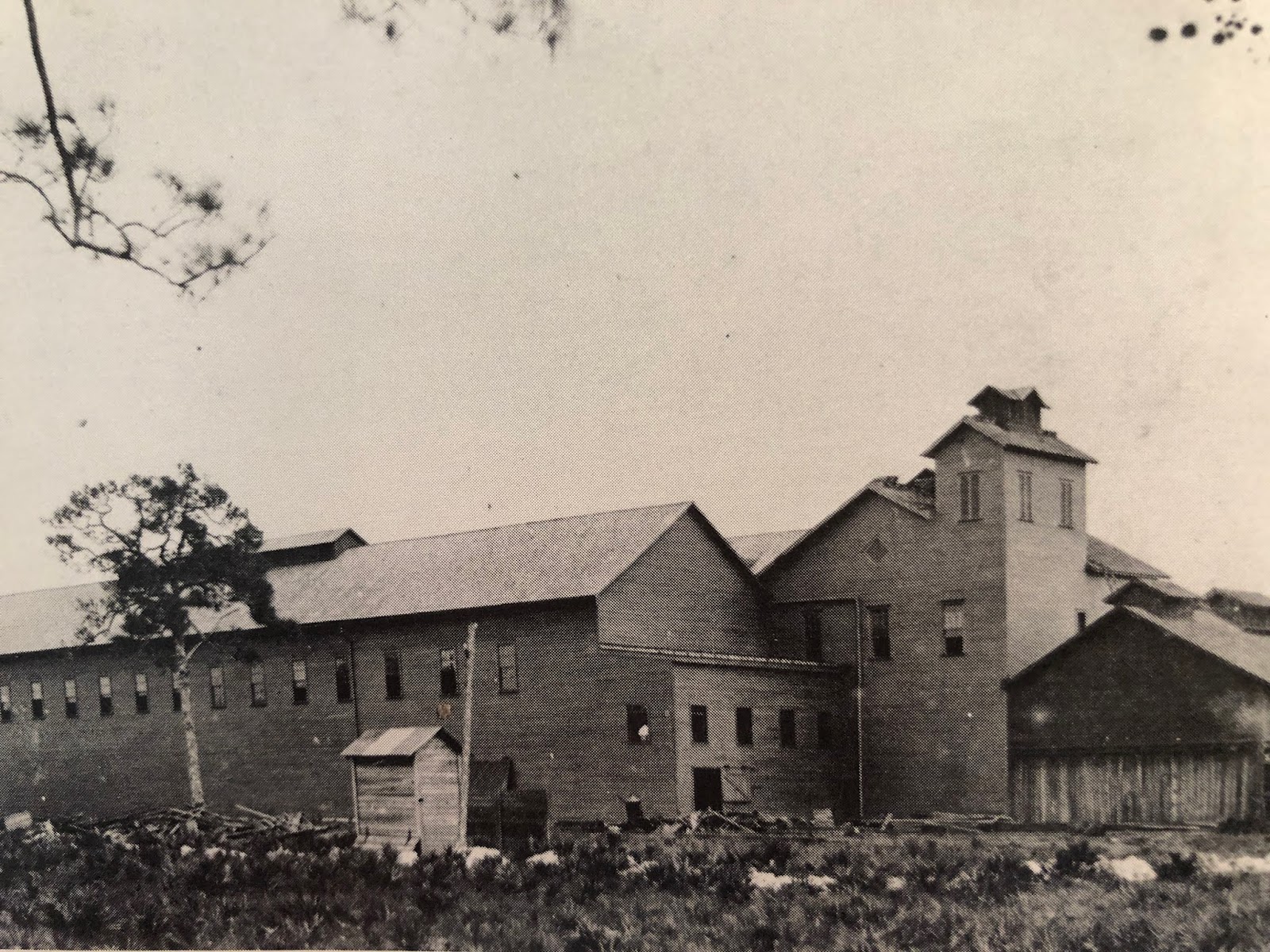
In around 1891 the enterprising founder of our town, Isaac Trabue, saw another way to help fund his retirement.  He opened the first Ice Factory designed to enable the delivery of fish north.  It was a steam-based plant located near Virginia between Berry and Shreve St.  The Florida Southern Railway ran through the area and onward west to the Long Dock which was located off the land where the Isles Yacht Club is today.  When you walk along the linear park in Punta Gorda, you are essentially on the beds where the railroad once ran. 

The plant turned out about 15 tons of ice a day, but only during the fishing season. Ice was slid down a shute to fishing boats that unloaded their catch over ice onto wagons where it was hauled back to the factory.  There it was packed onto box cars (on a railroad spur) for shipment on the Florida Southern Railway heading north from the Long Dock.  

Unfortunately for Trabue in 1895, a group of local businessmen organized another company, the Punta Gorda Ice and Power Company, that would be open all year, produce more ice per day, and be most importantly priced cheaper.  Townspeople thought that Trabue’s price for ice was exorbitant.  To make matters worse for Trabue’s plant, Henry Plant had fully acquired the Florida Southern in 1897 and his main business interests were in Tampa.  He pulled up the track leading to the long dock leaving Trabue’s plant stranded.

Not to be undone, in 1902 working with a group of investors from Philadelphia, Trabue opened with them the Consolidated Ice Manufacturing, Refrigeration and Fish Company with the intent of furnishing cheaper ice to the fish industry and then manufacturing fertilizer from trash fish.   The large plant was built in 1902 (looks as though from photographs that the remnants of the earlier plant were likely incorporated into the larger structure).  Then at the harbor near Berry a fertilizer building was constructed to process the fish for fertilizer.

This company failed to go into production and the building was abandoned and eventually torn down by the city after a small boy was killed by a timber that fell from the remains.  Remains of pilings on which the fertilizer plant rested can still be viewed near the Boat Club clubhouse on the bay. ( See earlier post about those remnants)

~Theresa Murtha

Sources:
Peeples, Vernon, Punta Gorda and the Charlotte Harbor Area
Williams, Lindsey, Out Fascinating Past
Maps and Photographs from the Vernon Peeples Collection, Punta Gorda History Center