Monday, February 15, 2016
Burnt Store Road History Revealed
Friday, March 8, 2019
170th Anniversary of Robert E. Lee's Visit to Charlotte Harbor
February 2019 marked the 170th anniversary of a little known visit to Charlotte Harbor by a US Army Board of Engineers as part of an inspection of the coast of Florida. Captain & Brevet Colonel Robert E. Lee was a member of the four officer Board and was the Recording Secretary for that Board. The other three members of the Board of Engineers were Lt. Col. R.E. DeRussy, Major R. Delafield and Bt. Col. J.H.F. Mansfield.
Sunday, February 12, 2023
The Story of the Man Who owned Charlotte Harbor Land 200 Years Ago
Richard S. Hackley: His Ownership and Survey of the Charlotte Harbor area Two Hundred Years
by Graham M. Segger[i]
There were several surveys of Punta Gorda and Charlotte Harbor completed prior to when Isaac Trabue and Albert Gilchrist came to town. Around 1849 John M. Irwin prepared a survey of Hickory Bluff on the north side of the mouth of the Peace River[ii] and between 1859 and 1872 teams led by John Johnson and Samuel Hamblen laid out a survey of Punta Gorda and Alligator Creek[iii]. Not nearly as well known is a much earlier survey of the area which was prepared 200 years ago, just after Florida was purchased from Spain.
On December 17, 1817 King Ferdinand of Spain granted a huge swath of the then Spanish colony of Florida to a favored courtier, the Duke of Alagon[iv]. On May 29, 1819 American citizen Richard Shippey Hackley purchased 12 million acres of this grant from the Duke, extending from Ocala in the north to south of Marco Island. Hackley was a relative through marriage of Thomas Jefferson, who had appointed him as U.S. Consul at Sanlúcar de Barrameda, Spain[v].
After years of negotiations Spain signed a treaty on February 22, 1819[vi] agreeing to sell the colony of Florida to the USA, effective Jan. 28, 1821, in exchange for assuming $5.0 million of debt[vii]. There can be little doubt that the Duke of Alagon was aware of these negotiations and agreements and in all likelihood sold to the well connected U.S. citizen Hackley in order to help shore up support for the title to these lands. Hackley helped fund the purchase by selling various parcels to US investors over the course of the 1820s and 1830s.
Hackley and his family established their own settlement base on the shores of Tampa Bay in 1823. This decision created conflicts with the authorities when in 1824 the U.S. Army decided that the Hackley compound was an ideal location for Fort Brooke, the new military headquarters for Southwest Florida. There are several comprehensive resources available which describe the Hackley Tampa settlement and the disputes over its title[viii].
What ensued was a protracted legal battle between the United States government and Hackley, his investors and his heirs. Hackley had some early successes but the United States government prevailed in 1838. The heirs of Hackley and others who had bought land from him continued with various legal appeals which were not finally settled until 1905 when the Supreme Court ruled against the Appellants[ix]. The basic flaw in Hackley’s claim was that the King of Spain had repudiated the grant to the Duke of Alagon in connection with the sale of Florida to the USA.
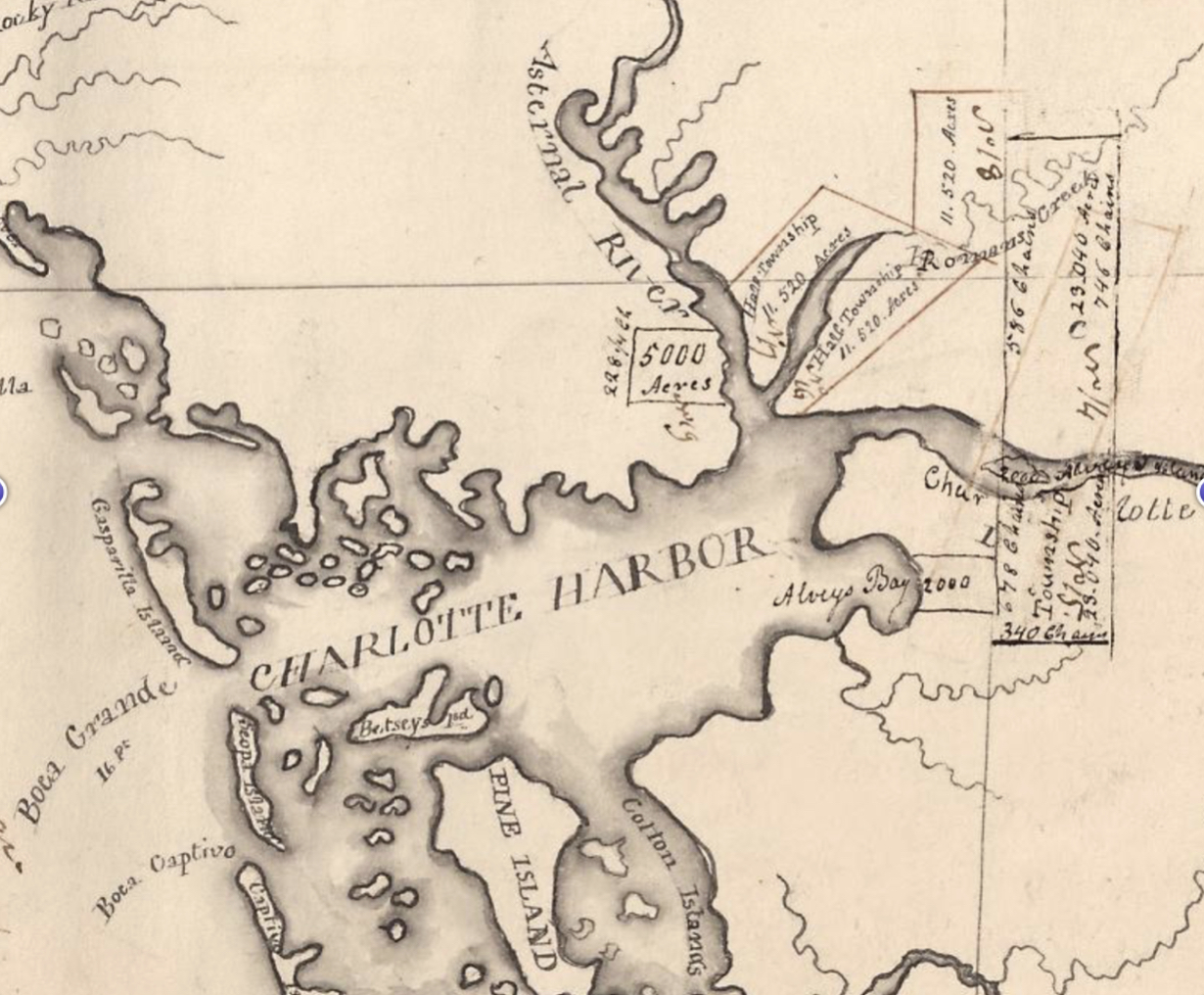
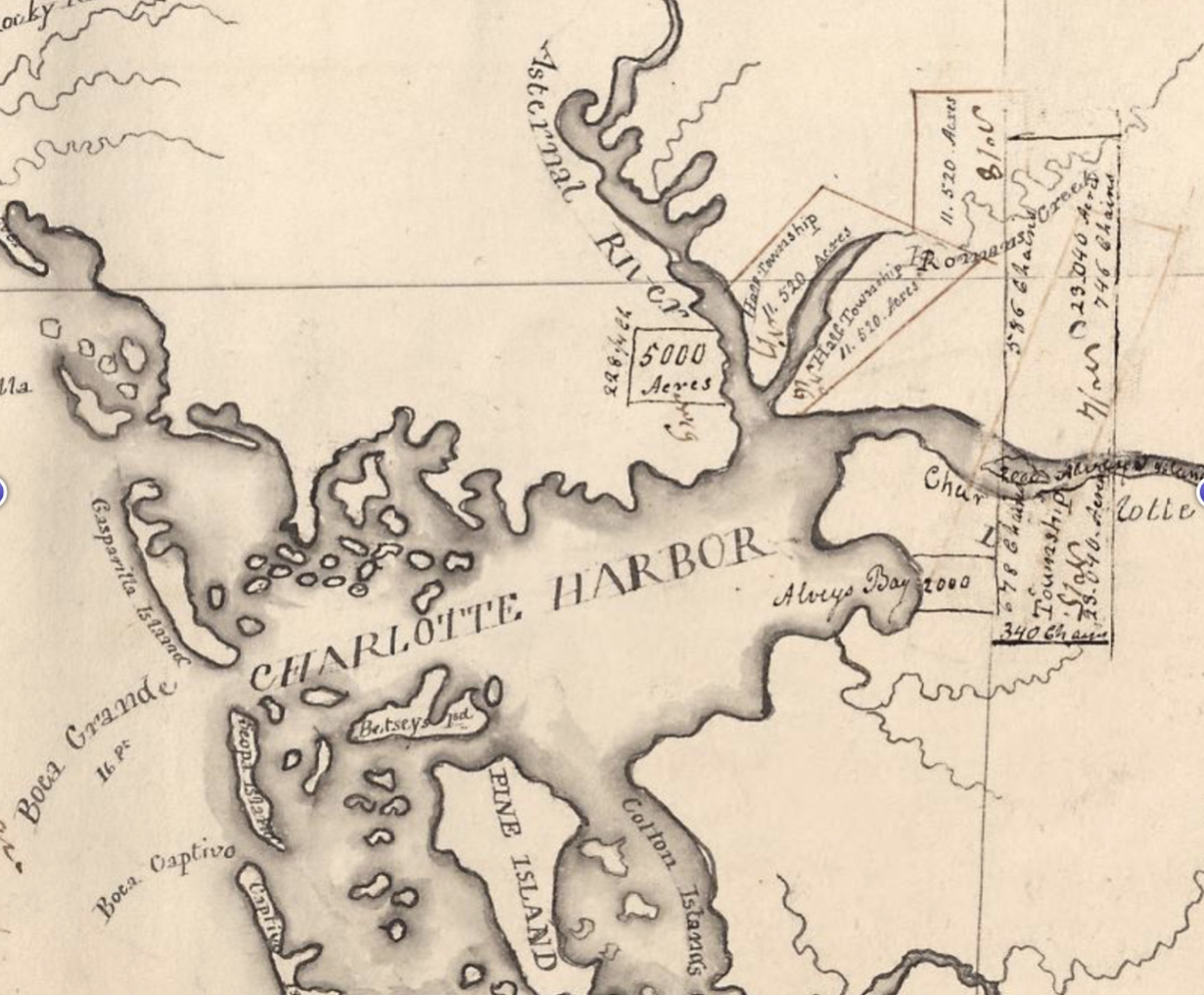
While a book could easily be written on the various legal twists and turns of this land title dispute[x], what is of most interest to the history of Punta Gorda and Charlotte Harbor is a map prepared for Richard S. Hackley in support of his efforts to resell portions of this huge land acquisition. The crop from the “Hackley Lands” map[xi]reproduced below is based upon a map originally compiled and drawn by Charles Vignoles and engraved by H.S. Tanner in 1823[xii]. The Peace River is labeled as the Charlotte River and the Myakka as the Asternal.
The copy of the Hackley map in the Library of Congress, with various township notations, is not dated[xiii] but may have been prepared in support of a Prospectus style document published in 1835[xiv]. Included in the promotional book was a letter from J.H. Randolph to Richard S. Hackley which stated:
“Charlotte Harbor is certainly the most delightful situation on the whole coast of Florida. In beauty of scenery, as well as in salubrity of climate, and quality of soil, no place on the coast can be compared with it.”
Written in the style of the unabashed land sale promoters which they were! This map also had some hand written notes in the margins signed by Richard S. Hackley which extolled the quality of the land.
The Florida “Hackley Land” was south of the boundaries of the 1827 Seminole Reservation established after the conclusion of the First Seminole War, but the townships south and east of Charlotte Harbor and the Peace River overlapped with the land set aside for the Seminole in 1842, after the conclusion of the Second Seminole war.
On June 2, 1832 one of R.S. Hackley’s sons, W. B. R. Hackley, embarked from Key West on a tour of the lands claimed by his father on the west coast of Florida. He was accompanied by Col. George W. Murray and Mr. P. B. Prior. An 1837 publication by John Lee Williams[xv], noted that the expedition passed many keys in Charlotte Harbor which:
“were under cultivation; producing corn, pumpkins, melons, potatoes, various kinds of beans, etc. The lime and cocoa nut trees on Caldes Island (Useppa) looked flourishing”.
The party also rowed up both the Caloosahatchee and Peace (which they called Macaco) Rivers.
The “Hackley Lands” map, reflecting several large tracts of land for sale near Alligator Creek, and straddling both the lower Myakka and Peace Rivers, is the earliest documentation of an attempt to subdivide the lands within what is now Charlotte County. Hackley’s title to the land may have been flawed, but the documents produced in connection with the enterprise provide facsinating insights into the Florida frontier prior to widespread American settlement.
Richard S. Hackley died in a financially ruined state in February 1843.
[i] Graham Segger is the author of Where Do We Live? aka The Burnt Store Road book (www.wheredowelive.com)
[ii] Scot Shively, Hickory Bluff Cemetery: A Charlotte County Pioneer African American Cemetery. Research conducted for the Blanchard House Museum of African American History and Culture of Charlotte County during the period February 2007 through January 2016
[iii] The first comprehensive survey of the Charlotte Harbor east shore in what is now Charlotte and Lee Counties was published by the Surveyor General’s Office, Tallahassee, Florida, July 20, 1872. The surveys were performed by John Jackson in 1859 and updated in 1871 by Samuel Hamblen. Copies of the original township and range maps can be located through http://www.glorecords.blm.gov/search/default.aspx#searchTabIndex=1
[iv] T. Frederick Davis, “The Alagon, Punon Rostro, and Vargas Land Grants, The Florida Historical Quarterly, Vol. 25, No. 2 (Oct., 1946), pp. 175-190 (16 pages)
[v] Sanlúcar de Barrameda is the port at the mouth of the Guadalquivir River which leads from the Atlantic Ocean to Seville.
[vi] The Transcontinental Treaty, also called the Adams-Onis Treaty
[vii] D. Luis de Onís, Memoir upon the negotiations between Spain and the United States of America, which led to the treaty of 1819 with a statistical notice of that country. Accompanied with an appendix, containing important documents for the better illustration of the subject (Madrid, 1820). From the press of D. M. De Burgos. Translated from the Spanish, with notes, by Tobias Watkins. E. de Krafft, Printer, Washington
[viii] Dan O., The Final Battle for Fort Brooke, https://www.tampapix.com/fortbrooke.htm;
Covington, James W. (1980) "The Hackley Grant, The Fort Brooke Military Reservation and Tampa," Sunland Tribune: Vol. 6 , Article 2. Available at: https://digitalcommons.usf.edu/sunlandtribune/vol6/iss1/2
[ix] Sallie Field Scott, Eliza Madison Scott, Harriet B. Jones, et al., Appellants., vs. Lizzie W. Carew, W. W. Hampton, E. R. Gunby, et al, https://openjurist.org/196/us/100
[x] Hackley published Titles and Legal Opinions Thereon, of Lands in East Florida, Belonging to Richard S. Hackley, Esq., (Brooklyn: 1982), printed by G.L. Birch. It provided background on the acquisition and numerous legal opinions supporting his claim.
[xi] Call Number/Physical Location: G3931.G46 1823 .H3, Repository: Library of Congress Geography and Map Division Washington, D.C. 20540-4650, dcuDigital Id: http://hdl.loc.gov/loc.gmd/g3931g.ct000882, Library of Congress Control Number: 2003620010, LCCN Permalink: https://lccn.loc.gov/2003620010
[xii] Call Number/Physical Location: G3930 1823 .V49 TIL, Repository: Library of Congress Geography and Map Division Washington, D.C. 20540-4650, dcu, Digital Id: http://hdl.loc.gov/loc.gmd/g3930.ct000731, Library of Congress Control Number: 2003627045, LCCN Permalink: https://lccn.loc.gov/2003627045
[xiii] Some writers have asserted that the map was created as late as 1904, but this is clearly inaccurate as it has margin notes signed by Richard S. Hackley, who died in 1843
[xiv] Richard S. Hackley, Documents in Proof of the Climate and Soils of Florida, in particular East Florida, (New York: W. Lunt Bradbury, Printer, 1835)
[xv] John Lee Williams, The Territory of Florida: Sketches of the Topography, Civil and Natural History, of the Country, the Climate and the Indian Tribes, from the First Discovery to the Present Time, with a Map, Views, Etc., (New York: A.T. Goodrich, 1837) – p. 289 – Charlotte Harbor at p. 294
Monday, January 4, 2021
A Yankee Visitor to Charlotte Harbor - 155 Years Ago Today
by Graham Segger
Scott De Wolf Collection. Image from Flickr courtesy of Florida Keys Public Libraries photo # MM00042290x
Those of us who enjoy reading
and learning about history will, from time to time, encounter a source that
pulls together many other diverse events, personalities or facts to make more
sense of or shed more light on all of them. This is exactly what happened when
I came across the 1865-66 journal of George Franklin Thompson which included a
section describing his visit to Charlotte Harbor and the Peace River. The
leather-bound volume chronicles, in 124 hand-written pages, a tour of
inspection through central and lower Florida including a visit to Fort Ogden from
December 31, 1865 to January 2, 1866 (155 years ago this month). The journal
was also supplemented by a series of five newspaper articles written by Mr.
Thompson for the Tallahassee Sentinel in 1867, though none of the articles
touch in any depth on his visit to the Peace River.
Thompson had been appointed to
this tour of duty as an Inspector for the Bureau of Refugees, Freedmen, and
Abandoned Lands, the federal agency charged with the task of overseeing
Reconstruction in a non-slave South. This was a politically sensitive role as
Thompson was an unapologetic Yankee and those he encountered in Florida were
understandably cautious and just a little suspicious about his motives. While
not a carpet-bagger as such, he did carry some baggage in the form of a
condescending attitude toward many of the Southerners he encountered.
What makes the journal of most interest to me is Thompson’s
account of his meetings with two of the significant personalities in the early
history of Southwest Florida. James McKay, Sr. of Tampa and Jacob Summerlin of
Polk County were conducting business at the McKay dock in Fort Ogden when
Thompson arrived at this outpost located ten miles up the Peace River from
Punta Gorda. Thompson describes in some
detail their characters, businesses and politics. Also present was Lt. J.C.
Shaw in charge of 39 members of the 99th U.S. Colored Troops. The
Fort Ogden dock was built in 1860, primarily to facilitate the shipment of
cattle from the Peace River valley and to deliver supplies to the cattlemen
entering the area after the close of the Third Seminole War two years earlier.
Florida Peninsular –
Oct 27, 1860, page 3 Source: University
of Florida Digital Collections
James McKay was a Scottish born ship captain who had arrived
in Fort Brooke (Tampa) with his family in 1846 and owned a merchandise store
there as well as shipping interests. He had been mayor of Tampa in 1859 and was
a leading citizen of that town (both a son and grandson also became mayors of
Tampa). During the Civil War he regularly ran the Federal blockade with his
ship from Tampa and Fort Ogden and was detained then released in Key West in
1861 and then captured with his ship and imprisoned in Key West in 1863. There
is much speculation about his true allegiances after being released again and
some have theorized that after 1863 he may have been working covertly for the
north. Thompson noted about James McKay that “during the war he however floated
with the current into secession and I presume with the defeat of the rebellion
glided as gracefully back to Unionism as any man in Florida”.
Jacob Summerlin was the largest cattleman in southern
Florida operating from his base in Bartow. George Thompson claimed that Summerlin
had 15 to 20,000 head of cattle to draw from. Thompson described Mr. Summerlin
as “a man of naturally great will power but devoid of culture in any of the
refinements of life. The poor look up to him as their superior and revere
his ideas as law. Though rough & uncouth in exterior from what we
learn of him by others I believe he has a kind heart for quite a number testify
that during the war he assisted the families of both refugees and rebels and
relieved a great amount of suffering by furnishing bread and meat to them”.
Later in life (1875) Summerlin became the first President of the Orlando City
Council and his family name still lives on as a major thoroughfare in Fort
Myers leading down toward the cattle dock he built in Punta Rassa. Thompson further
reported that “Mr. Summerlin had a party of ten or twelve men with him to herd
and load the cattle. They are the poor class in the country & termed
"crackers." They were as a class entirely destitute, ignorant and
generally ambitious only for enough to eat regardless of quality to satisfy
their hunger. They are governed almost exclusively by the cattle proprietors
and present a sorry spectacle of what depths of ignorance and stupidity human
nature is capable.” Ouch!
Summerlin was a pragmatic businessman who sold cattle to
both the Confederates and the Union. He responded to a question about the
politics of the locals by saying "I will tell you sir, though they pretend
to accept the result [of the war] yet their hatred is just as intense as ever
and if an opportunity is offered by a quarrel between France and the United States
they would do all they could to break down the government.”
Thompson traveled to the Peace River on a small sailing
boat captained by Louis Bell of Tampa. In his journal he recounts an
interesting encounter on the night before passing Punta Gorda and arriving at
Fort Ogden. “At dusk cast anchor near an island about 7 miles from mouth of Peace
Creek. Here we were attacked by Musquitoes at first by Brigade then by Division
and afterwards by Corps and doubting our ability to withstand their charges we
concluded it would be wiser to retreat. Consequently we fell back about two
miles and passed a miserable night in the boat.”
At Fort Ogden Thompson dined onboard James McKay’s steamer the Governor Marvin (formerly the USS Honduras which was active during the Civil War as part of the federal blockade of Florida ports and the May 1864 capture of Tampa).
Thompson reported that McKay was buying cattle from Summerlin for $10-$15 per 350 lb. cow for transportation then sale in Havana for $17-$27 per head. Thompson further described McKay as a “large commanding person of open, frank countenance gentlemanly & kind to everyone he meets. Full of energy and enterprise he gives to Tampa whatever of life and business it possesses.”
Thompson had this to say about the settlement prospects in
the area. “In this section I think a
population would be obliged to depend upon the clouds rather than springs for
their fresh water [due to the brackish nature of the water from wells].
We here find plenty of game such as deer, snipes & ducks, & wild
turkeys. The river is well supplied with fish, mullet being the most
common”.
After leaving the Peace River Thompson visited the
Caloosahatchee River, Fort Myers and two fishing encampments at Punta Rassa and
Useppa Island. He did not reserve his negative views to the cattlemen of
Florida. On January 7th, 1866 he reached Captiva Island where he
camped for the night and had this to say about its prospects “this island is
good for nothing except to help hold the world together and afford a resting place
for weary travelers.”
Guest blogger Graham
Segger is the author of Where Do We Live? Research by a Seasonal Resident of
Burnt Store Road (aka the Burnt Store Road Book). His book is available at
local book stores and also online at www.wheredowelive.com with all proceeds to charity. The material
for this blog was first identified during research for a February 28, 2019
lecture about Charlotte Harbor Pre-1865 at Florida Gulf Coast University’s
Renaissance Academy in Punta Gorda. For a summary of Mr. Thompson’s life and
the full text of the journal and newspaper articles describing his 1865-1866
visit to Florida see the online transcription by James G. Cusick of the P.K.
Yonge Library of Florida History at https://ufdcimages.uflib.ufl.edu/UF/00/09/62/85/00001/GeorgeFThompson.pdf.
Wednesday, April 3, 2024
Another Humorous Burnt Store Story by Wallace Chapman
Burnt Store’s Hall "Wins" Case, and Without Lawyer - Gets Just What He Asks For
The following story, discovered by Graham
Segger during his historical research, was published 103 years ago under the
byline Wallace Chadman, Punta Gorda in the March 19, 1921 issue of the Tampa
Sunday Tribune
Mr. Al C. O. Hall, a
semi-prominent house-holder of the Burnt Store district, and a member of the
Witenagemot of that place, appeared in Justice of the Peace court early
yesterday morning and voluntarily confessed to being guilty of the misdemeanor
of intoxication. He asked the court to administer a stiff fine, the highest one
the law permitted. The Burnt Store district lies southeast of Punta Gorda, and
is a fertile tract of land which is rapidly being settled. The place had never
been given a name, and a few years ago when an old store was consumed by fire,
the appellation, "Burnt Store" was given it.
The justice entered
the case in the criminal part of his docket with great reluctance, probably on
account of the prominence of the gentleman, and even suggested that the docket
entry could just as well be "State of Florida vs. John Doe," in order
to conceal the real name of the defendant: but to this suggestion Mr. Hall
vigorously objected, and strenuously insisted that the entry set forth his real
name and the true state of affairs. He demanded that a complete record of the
case be made, including his plea of guilty as charged by himself, so that it
would always show up against him and so that he could refer to it at any time
during the remainder of his natural life.
"And now, jedge"
continued Mr. Hall, as the justice finished the entry of the case and the
confession of guilt in open court, "now, jedge, if you are ready to assess
and apply the fine, I desire to say a few words tending to convince the court
of many and manifold aggravating circumstances, facts, details and items, which
call for the heaviest fine known to the law of the land and warrant the
assessment of it against me."
The amazement of the
Justice at this speech cannot be described. Never in his long career as a
justice of the peace had such a plea been entered in a case before him. He
pulled his feet down from his desk and in so doing nearly capsized backwards,
but finally righted himself, squared around, and told the gentleman to proceed.
Mr. Hall's Sad Story
"Jedge, I’ve saw
these here sharp and lean lawyers get up in court to represent someone that
didn't want to lie for himself, but had pleaded guilty because, it was cheaper
to do that than to try the case; and them there lawyers would spiel to the
court about what they called 'extenuating
circumstances - and they’d orate and promulgate and expostulate on the
proposition why the smallest fine in the book would be as much as was desired
by the defendant in the case at bar, and they'd pray the court for mercy and
leniency and clemency, and to please make the fine so small that there 'ud be
enough left of the feller's farm for a fee and they'd lay great stress on the
claim that it was a first offense, and they'd guarantee that their client would
never again, never, commit the first offense again, and so on and so forward.
"And, jedge, in
many cases the court would bring himself to believe that the ends of justice
would he served by considerin' the extenuatin' details, and he'd administer the
minimum fine to the defendant, and then the 'tarnal lawyer would charge a double
fee because he had got the fine so low. Now, jedge, I am acting as my own
lawyer in this case because I was afeared that if I got a lawyer to enter this
plea of guilty he'd twist it around some way, and get you to refuse it, and
discharge me, and then he'd charge me five hundred dollars for getting me
cleared when I didn't want to be cleared.
"Jedge. I'm only
a plain, blunt man like Hark Manthony was in the time of Caesar, and I can't
overwhelm you with eloquence and citations from the annotated decisions of the
police court of Wauchula, but if you will grant me a little time I shall try to
show you why I should be imposed with the biggest fine that a Burnt Store
resident ever drew.
"In the first
place, jedge, I went into that state of intoxication of my own free will,
aforethought, and premeditated, and as voluntarily as a grown up girl lets her
mother do the cookin'; and it wasn't my first offense by a good'eal, tho' I
hope it may be the last one; and I didn't even consider the kind, quality or quantity
of the swig I was fillin' up on, and I didn't care whether it was rainwater,
oatmeal mash and alcohol, or alcohol, rainwater and oatmeal mash, or
vice-versa, and when I had imbibed about five gallons of it I didn't care for
home, friends or work, death, hell, heaven, or lying in state in purgatory a
few months. I'd throw my money into the streets or spend it for something I
didn't need any more than a grasshopper needs hard coal in winter.
"And jedge, may
it please your honor, when I got to the highest point of my souse on that amalgamated
swig. I'd stand right up anywhere or everywhere, and, right in the faces of all
the Websters - Daniel, Noah and Zeke - deny that there was any such thing as
'morality,' and bet them fifty bucks that their old dictionary didn't contain
such a word; and I'd argue and dispute and contend that there wasn't any
difference between good and bad, and that, if there was the bad they had the
best time by far, and I’d growl at my friends, curse my relatives, load the old
shotgun for my enemies, claim the whole earth and the rest of the family of
planets, and threaten ejectment proceedings against everybody whose name
appeared in the last census book.
And, jedge, just one
or six more words and I am through. I don't claim that I was drunk and went
about the streets of Burnt Store staggering like an underfed dog. But I do
claim I was intoxicated - poisoned - had taken something by mouth which had a
toxic or poisonous effect; and that's one of the chief reasons I am entitled to
receive at your hands the highest sum that ever went into the fine and forfeiture
fund. Jedge, I should never have prosecuted myself if I had gone to the places
where it is possible to procure an old-fashioned, good-natured, good-feeling,
good-everything, good-night jag, and gotten up in the morning with pleasant
memories of the evenin' and hearty hopes of a repetition thereof without
running any risk of making more work for the undertaker. And then, jedge, if my
time limit has not been reached, look at the business side of it. What was my
truck farm doing while I was on that diet of gasoline and boiled sorghum? Not a
thing. Nothing working but ground moles and leaf curlers. Why, I was even glad
and rejoiced to say, 'to perdition with business; I'll be there to take care of
it in a few days.'
"And, now,
jedge, thanking you for your attention, I ask that I be given and granted the
heaviest fine that the statutes of law provide, and I submit that I am entitled
to it for the reasons adduced."
The justice entered
up the highest fine provided by law, and 'Mr. Hall took from his clothes a roll
of bills big enough to dam Fisheating Creek during a flood and threw it upon
the desk. The change was made and Mr. Hall stuffed the balance into a gunny
sack and kicked it out into the hall. "Who says that I can't win my own
suit without a lawyer?" said he, as he prepared to depart.
"You presented
your case very well," said the justice, "and were entitled to the
decision. I am glad you are satisfied with it; but isn't there something back
of it all? A bet or a wager or a promise or something like that?"
And the Explanation
"Jedge, if you
agree not to reverse yourself or remit that fine, I'll give you some further
information." "I agree." said the judge.
"Well, about
three months ago our family physician hinted to my wife that he believed I had
tuberculosis, and it frightened her almost to death. She mourned around the
house as if I was already dead and the insurance company wouldn't settle. One
day my Aunt, who had over heard talk about my ailment, said to my wife:
"What you-all mo’nin’
about? My ole man was as full of dem tubercule
germs as a fe’ther bedtick is full of straw, and he et only one meal a week.
One day a man comes along an' he says he could b’l up a dicocshun what, 'ud
kill germs as big as anerconder rattlesnakes. An dem dar two men, dey jis keep
my boilers and pots red hot fer two days, an' then they drink up that extrac'
and my ole man laid around like daid for five days. Den he done gits over it,
an' ah hain't seen or heerd a sign of a germ about him since.'
"So, jedge, I
thought I'd try Auntie's remedy, and I must say that I'm ready to give a
testimonial to any concern that puts a patent on that stuff.
Graham has been researching the life and writings of Wallace
Chadman, who wintered in Punta Gorda from about 1912 to 1924. For a time he was
the town’s attorney,and was also a regular contributor of humorous stories to
various newspapers across America. A Tampa Tribune article of February 14, 1918
described him as follows “sage, philosopher, lawyer and humorist, of Punta
Gorda. Chad’s philosophy of life is to make at least two smiles bloom where one
flowered before.”
Tuesday, February 15, 2022
The Protein Products Corporation – Where Burnt Store Marina is Today Part 2
Graham Segger
The Business Plan and Approvals
On April 18, 1966 Lee County Zoning Board approved a plan to establish a fish meal processing plant on the shores of Charlotte Harbor just south of the Charlotte County line and just off Burnt Store Road. This plan had been approved or endorsed by the County Planning Board, the Chamber of Commerce and the Committee of 100. The proponents made many optimistic promises, which included constructing five buildings (an office building, factory, cooling and grinding facility, warehouse, and net storage & chandlery house). The factory and incinerator would have 50 foot stacks. There would be a 200 foot dock and seawalls at the harbor, in addition to the dredged channel to deep water. They projected a capital expenditure of $500,000; annual revenues of $1.5 million; local economy spending of $1.0 million per year; and employment of 20 staff and 40 fishermen. The company pledged itself to be “a good industrial neighbor” and claimed that “conservation is our life blood”. They cited several successful operations in N.J. and Massachusetts, and committed that there would be no water discharges into the harbor. The owners were R.T. Angster and D.A. Vincent of Tampa; Production Manager was to be David Kalashian; and Secretary-Treasurer / Sales & Office Manager was Charles B. Davies.
The proposal had not been without opposition. Fish broker Leon Kenney of Pinellas Seafood in St. Petersburg was a vocal opponent citing evidence that similar operations in Mexico had been unsuccessful and had diminished the local food fish stock. Jesse Padilla of Pine Island, a local leader in the fishing industry, provided the following prophetic statement to the local press at the time “I think we are going to wish we had never heard of a fish meal plant”. The U.S. Bureau of Commercial Fisheries supported the business plan. The company proceeded to purchase 76 acres for $50,000 from Mr. & Mrs. Richard M. McConnell, and obtained rights of way to Burnt Store Road. The land included 400 feet of Charlotte Harbor waterfront.
The actual operation involved obtaining, through the fishing efforts of large purse seine trawlers, tons of small inedible fish, typically Menhaden and Thread Herring (aka hairy-backs). These “trash fish” would then be processed into fish meal and solubles to be used as animal feed and fish oil for export. End use included additives for poultry feed and raw material for margarine (international market only for the latter).
The trawlers would be out for several days so the fish were to be brought back in to the dock refrigerated at 25°F. Water was then pumped into the hold to loosen the fish and the slurry would then be pumped back through a six inch pipe to the processing factory. The water contained blood, scales, and oily substances from the fish and was commonly referred to as “stinkwater”.
Operational and Regulatory Challenges
In October 1967, just months after the plant started operating, reports of a huge spill of “greasy fish gruel and rotting fish” were reported by fishermen on the east wall of Charlotte Harbor. Vultures by the hundreds and catfish in schools descended upon the nasty overflow from the plant. A commercial fisherman living on Yucca Pen Creek saw large mullet floating dead at the mouth of his creek and another fisherman reported that the discharge was hanging from the mangroves. The company claimed human error caused the spill of the “stinkwater” but the plant was closed for a period while process improvements were made.
Also in 1967, four captains on two large trawlers employed in harvesting the non food small fish were charged with also scooping up food fish with their nets, which was strictly against the law and operating authorizations. Charles Davies, the Protein Products Corporation manager, stated that it was “physically impossible” to not catch some food fish. He claimed his trawlers captured only .02% food fish in a 268 ton catch, which seems a little hard to believe given that a purse seine net is gathered from the bottom and scoops up all of the fish above it.
On November 25, 1967 the Lee County Chapter of the Organized Fishermen of Florida asked for a purse seine ban in territorial waters (3 leagues (10.4 statute miles) out from shore). On February 27, 1968 Florida imposed a ban within five miles of the Lee County coastline and ten miles from the Collier County coastline. This was sponsored by Rep. Ted Randell.
Tragedy at the Dock
On the morning of Sunday, August 11, 1968 the Novelty, a 125 foot long steel trawler, docked at the Protein Products Corporation dock with a 50 ton catch after four days of fishing off Sanibel Island.
It is difficult for me to relate the horror of what ensued that morning so I have opted to include the quotes by Lee County Sherriff’s Department Investigator James Loeffler and Fireman William H. Conrad provided in the August 12, 1968 Fort Myers News Press article by Patrick Kelly.
“Frances D. Webb, 23, of Peace Dale, R. I., the boat's pilot, had descended into the hold about 9:30 a.m. to start to flood it. This was not only to wash off the catch of mostly "trash fish" netted the night before but was also intended to provide a means of transferring the cargo to the fish meal plant by floating it out of the large [six inch] pipes made for the purpose. Several crewmen and most of the dockhands stood watching Webb through the open hatch. Without warning, Webb collapsed and Frances L. Winter, 53, of Punta Gorda [and originally R.I.] jumped through the hatch to help him. But, it immediately became obvious Winter himself was overcome and his brother, Joseph K. Winter, 55, also of Punta Gorda [and R.I.], went to rescue him. He was also immediately in trouble and, as fumes arose from the still gushing water in the hold, other men began to show signs of being affected. Stephen F. Richmond, 18-year-old 2nd engineer, from Wakefield, R. I., who had been standing at the door of the galley, toppled over into the hold, lifeless. Kenneth Smith, 55, Matlacha Station, operations manager for the plant, who lived in a trailer on the property, likewise was overcome and fell into the hold. By this time, a frightened dockworker, using the mobile telephone equipment on the trawler, called for help. He reached the police department in Punta Gorda.”
On arrival, Loeffler said, he became aware of the first bit of heroism.
“A dockworker named Roy McNeely had descended into the open hatchway, holding his breath. By using a rope, he was able to rescue Lawrence Finley, 33, of North Port Charlotte [other newspapers cite eye witness accounts which identify the brave rescuer as Frank Martin, who went down into the hull and placed a hook around Finley’s belt]. But Finley was unconscious and appeared to have stopped breathing. Unaware of the nature of the poisonous gas, the ship's cook, one-armed Clyde Parrish, 56, of Punta Gorda had immediately begun mouth-to-mouth resuscitation and Finley began to show signs of recovery. He was rushed to the Charlotte Medical Center Hospital in Punta Gorda [he did recover]. Parrish's life-saving effort was a definite act of heroism. When the Fort Myers rescue unit arrived, Firemen Henry C. Howard and William H. Conrad immediately radioed for gas masks and air-packs. While this equipment was on its way to the scene, Conrad decided to attempt to get to some of the bodies in the hold any way he could. With the help of his fellow fireman, Howard, and Deputy Coleman, Conrad fastened a rope around his waist, took a deep breath of fresh air and dove into the hold. He succeeded in getting another rope around Smith, the last man to fall. Still holding his breath, Conrad and his helpers got the body to the dock. "But it was obvious there was no hope," he said. "The man's face was black. He was gone." Conrad repeated his rescue attempt with the body of young Richmond which "seemed to be twitching" as it floated in the water in the hold. But Richmond, too, had died. Recovery of the remaining bodies was made after Fireman Lester Landrum arrived with the gas masks and air-packs. There was considerable confusion on the dock as efforts were made to appraise the situation and identify victims. The Novelty's skipper, Capt. Ralph Robert Smith, about 50, was overcome briefly on deck but revived before his condition became serious. The Protein Products plant grounds and the ship have been sealed off by order of a maritime officer of the U. S. Dept. of Labor.”
Cause and Effect
While it was generally acknowledged that the gas which was generated when the hose was turned on precipitated the deaths, in the days following the tragedy there was much speculation about the actual source and nature of the gas. After autopsies and tests of the ship and processing plant were performed, Dr. Wallace M. Graves, a Fort Myers pathologist, confirmed that hydrogen sulfide was the lethal gas. It can be produced by decaying organic matter. Thornton Laboratory of Tampa, working for the Coast Guard, determined that the slush water in the cargo area contained 564 parts per million (ppm) of hydrogen sulfide while toxicity levels are normally 20 ppm. Lethal levels were also found in the hose and storage tank which the water was pumped from. The plant had operated for a single day a week earlier but not for the month prior to that due to lower summer fish harvests. Protein Products Corporation and its insurer commissioned a report to determine how the disaster occurred but it was never made public. Sherriff’s Investigator Loeffler stated that he did not press for the report or lay any charges. A Florida Industrial Commission officer stated in September 1970 that it was never fully determined what combination of equipment or circumstances caused the deaths. Civil cases were unlikely given the shaky financial condition of the Corporation.
A month after the accident the storage tanks were stabilized by Inter-Science Research and Engineering of Tampa through an oxidization process, and the treated fluid was dumped 20 miles out into the gulf.
The plant reopened 15 months later in November 1969 but due to low fish catches it began closing up again in March 1970. Richard T. Agster, the Corporation president, stated in September 1970 that “the Legislature put us very much out of business”. He was referring to changes to the purse seine fishing and food fish harvesting rules.
On September 28, 1970 there was a foreclosure sale auction of the company land and equipment. This was a result of a claim for $511,809 plus interest by Tampa Ship and Dry Dock Co. Inc., incurred while building the plant and facilities. The September 23, 1970 Auction Notice provides many details about the type of equipment employed in the operation.
In June 1971 the plant had a brief resurrection when it was used to process hyacinths into fertilizer. These had been harvested from the clogged Hendrickson Reservoir on Shell Creek, which at that time was supplying Punta Gorda with its fresh water.
Punta Gorda Isles, Inc. purchased the land shortly thereafter and combined it into the 3,000 acre Burnt Store Marina (BSM) and Burnt Store Lakes (BSL) development plan first made public in October 1972. The Lee County development plat for BSM was issued in June 1973.
Protein Products was not the first to consider a fish processing plant on the east wall of Charlotte Harbor. In 1932 “Wild Bill” Belvin, the Pine Island Road resident who received country-wide notoriety in 1930 for living alone off the grid for a year on the shores of Charlotte Harbor (three miles south of the Lee-Charlotte county line), came up with an interesting scheme. While working with Punta Gorda Fish Company fishermen on Crow Key and Bull Key, he conceived a technique for turning predatory fish and fish scraps into fish meal and fish fertilizer. The product was made by the process of cooking and drying. The fertilizer was produced by the addition of potassium chloride and muriate of potash to the dehydrated fish scrap. Examples of his product were presented to the Fort Myers Chamber of Commerce in November 1932, but I have found no record of a commercial operation being established.
Most of the material for this article was sourced from over 30 news articles published between 1966 and 1972 in the Punta Gorda Herald, Fort Myers News Press, Tampa Bay Times, Tampa Tribune, St. Petersburg Times, and Miami Herald.
Wednesday, February 2, 2022
The Protein Products Corporation on Burnt Store Road - Where Burnt Store Marina is Now - Part 1
By Graham Segger
Readers of my book about the history and geography of Burnt Store Road may recall a reference to a business operating on the Burnt Store Marina property prior to the development of the harbor and the residential community. That company was the Protein Products Corporation which owned the land now occupied by the harbor. They operated trawlers which used large nets to haul in tons of small inedible "trash fish" for processing into fish meal in a smelly plant.
Image
1 - Yucca Pen Creek and the Burnt Store Marina coastal area property ownership
map of 1969 – Section 1, Township 43S, Range 22E
In early 2020 I discovered, in the archives of the Punta Gorda History Center, several aerial photos dating from the late 1960s which provide new detail of what the harbor looked like while this business was operating. The photos appear to originate from two different periods reflecting slightly different configurations of this business enterprise. The citation on one of the photos describes the operation as a “fish meal place for pet food”. I’ve been told by old time residents that the company would store the fish in shallow dredged ponds prior to processing. The first two photos reflect dredging operations in progress in both the channel and on shore.
Image 3 – View from the harbor The next photo shows a more mature business operation
with several large buildings for processing the fish and a trawler at the dock. Image 4 – Protein Products Corporation fish meal processing plant A recurring story which I have heard is that the plant was closed after five employees tragically died in an industrial accident. The Protein Products Corporation was incorporated in Tampa on November 2, 1965 and was dissolved on July 11, 1972. The dissolution corresponds with the time period when Punta Gorda Isles, Inc. purchased the land and then registered the Section 22 subdivision development plat with Lee County. Read the rest of the story here.
The
three aerial photos above are from the Vernon Peeples Collection, Punta Gorda
History Center. Graham’s book about Burnt Store Road titled Where Do We Live? contains
many more early aerial photos and is available at local Punta Gorda book stores
or by emailing wheredowelive.bsm@gmail.com. An eBook version is available at
www.wheredowelive.com. |
Saturday, March 25, 2023
The Strange Case of Bill Zurick
Harrison Jones came up from the Burnt Store district on lower Charlotte Harbor yesterday and spent the greater part of the day going about town making purchases and laying in a stock of provisions to last him through the fall season. Mr. Jones is a busy man, so busy that he gets to the city but two or three times a year. He is operating a small sawmill at the Burnt Store, clearing off a good farm and already has some sixteen acres of a citrus grove well along toward the age of bearing.
Mr. Jones related a story of the peculiar affliction which recently befell one of his neighbors, and it is a story very interesting to the laity and very puzzling to the medical profession here. The name of the neighbor is Wilhelm Zurick, a Swiss, who something over a year ago moved upon a section of land in township forty-two, range twenty-two, a distance of about a mile from Mr. Jones' residence. Zurick has a large family and a very small house; in fact, he seemed content to take up his abode in the tumble-down shanty which had been erected by the former owner of that section. Although there is splendid timber on the place, Zurick did not have any of it made into lumber with which to repair his abode, neither did he trouble himself about putting out crops or bringing his place into a state of cultivation. How he managed to procure sufficient food and clothing for his family has been a wonder and a topic of discussion among all who knew him or of him.
Some of the neighbors thought Zurick's disinclination to work was the result of ill health, while others declared that his ill health was the result of his disinclination to work. As a matter of fact, Zurick is a sort of hypochondriac, and besides his morbidness and melancholy, he believes himself the victim of many different forms of disease. Having no money with which to purchase medicines, or drugs, he has been in the habit of hunting through the woods for medicinal herbs, barks and roots. These he would take home and boil in a large kettle which he picked up from the beach near Cape Haze light. On many occasions he professed great relief after dosing with the brew thus obtained.
One day, several weeks ago, he came in with an armful of a peculiar and suspicious looking plant. It was not unlike, in appearance, the black snake root, which abounds the entire length of the Appalachian mountain system. His wife cautioned him about fooling with strange herbs, but Zurick himself immediately put the plant to boil and seemed eager to test its medicinal efficacy. He was then complaining of shooting pains and lameness throughout his entire muscular system. In nearly every instance Zurick's illness affected his muscles. Having boiled the herbs two hours and twenty minutes Zurick pulled the fire from under the kettle so that the liquid could cool. Later he obtained a piece of cloth from his wife and strained the concoction into a small pail. Just before supper he drank a glass of the liquid, and early the next morning he took another, followed by one at noon. Toward evening a great change came over Zurick. He was seized with an unconquerable desire to work. He arose from his chair on the porch and briskly walked to the woodpile, where, within half an hour he split a heap of wood as large as the slab pile of a small sawmill. This strange action frightened his wife, who had for years gathered up or spilt the wood with which to cook the meals. She tried to get her husband to come into the house and lie down, but he refused and, seeing a shovel leaning against the fence, he grabbed it and began digging a ditch to drain the water away from the house. This ditch had been needed ever since the Zurick family took up its abode at that place.
Having finished the ditch and straightened up the gate post, Zurick suddenly remembered that it was about time to make up the seed bed. Streaming with perspiration, he attacked the bed, which is about twenty-five feet square, and, although the sun was sinking, and his wife was calling supper, he stuck to the work until he had the bed entirely spaded and raked as smooth as a floor. Next morning Zurick took another glass of the mysterious brew, ate a hearty breakfast and by 7 o'clock was in Punta Gorda buying wire to fence his northeast quarter. In the afternoon he ran the fence up and cut a good road one-half mile long on his way in.
Mrs. Zurick had never before seen such symptoms manifested by her husband and her fright bordered on hysteria. She was sure the strange herb was the cause of it, and she knew her husband would kill himself in a week by overwork. She sent for a physician, who arrived at noon on the third day after Zurick began taking the juice of the unknown herb. The doctor took the sick man's wrist and began to count, but Zurlck, happening to glance upward and seeing light through the roof, jerked his arm away from the doctor’s grasp and in an incredibly short time was on top of the house, nailing shingles over the hole.
After he came down, the doctor completed his diagnosis, but not without several interruptions caused by the patient seeing something to do and immediately doing it. The doctor asked to see some of the juice, but it could not be found. It seems Zurick had hidden it.
Up until August 26, Zurick had grubbed, burned, plowed and drained ten acres of his land, had felled over 600 trees, and hauled half of them to Mr. Jones' sawmill. It is impossible for him to resist doing work that strikes his eye, and seems to be under some uncontrollable impulse. That explains why he was found doing unfinished jobs on the farms of his neighbors. He cannot sit still if his eye falls upon something that should be attended to, no matter what or where it is. The physician thinks that Zurick's nerve functions have been completely changed around by the action of the mysterious herb. This seems to be the correct diagnosis since Zurick's reflex nerves are now dead and refuse to act. Flies, bugs, mosquitoes, and other insects strike him in the ball of the eyes without receiving any opposition from the reflex action of the eye lids, and Zurick never winks until after the object has lodged on the outer membrane of the eye. While on the other hand, all the common nerves have been changed into the kind possessing reflex action. At least this is proven by the effect which the sight of undone work has upon Zurick. He cannot resist pitching into it, and cannot stop himself until all work in sight is done.
A number of our prominent physicians discussed Zurick's case informally at a meeting held last night. They unite in the belief that Zurick is impelled by some stimulus or excitation entirely without the usual intervention of consciousness, and that he performs the work involuntarily, impulsively and without the slightest desire or volition on his part. They discussed learnedly "afferent" and "efferent" nerves, "reflex action," and so forth, but were unable to explain just what has taken place in the nervous system of Zurick. They are satisfied that Zurick's muscles are not under the control of his will. Even laymen are satisfied about that.Meanwhile, Zurick is simply tearing that section of land to pieces. His wife can induce him to take rest only by placing his chair "where his eyes can rest on work absolutely completed”. He brings in quantities of the herb each day and boils it so that he can have it fresh. His case is the talk and wonder of the entire county.
While no author was listed, it is Graham’s theory that this story was written by Wallace Chadman, who wintered in Punta Gorda and spent summers in Tionesta, PA between 1911 and 1926. Chadman was granted the designation AAA by his colleagues at the local beverage room – Attorney, Author and Angler.
There was in fact a back story to this tongue in cheek account of Mr. Zurick. A group of 15 Swiss immigrants did establish a colony near what is now the corner of Durden Road and Old Burnt Store Road in August 1913. Newspaper accounts in November 1913 state that the town site was to be called Klaricka, had a sawmill, and was in the vicinity of the old Burnt Store.